
A year ago, AI in law firms meant a partner asking ChatGPT to summarize a document. Today, firms are hiring dedicated AI automation specialists, sometimes as a full-time hire, more often as a contracted expert, to handle intake, document review, and client communication at a scale associates can’t match on their own. Firms that made this move report cutting response times from days to hours without adding headcount. Here’s what’s driving that shift, and whether it makes sense for your firm.
What Changed: Why Now?
Two things happened at once: AI tools got good enough to handle real legal workflows (intake triage, first-pass document review, drafting routine correspondence) and client expectations shifted toward faster response times. A firm that takes three days to respond to a new inquiry is losing that prospect to whoever responds in three hours. Automation closes that gap without adding headcount to every department.
Where Firms Are Actually Using AI Right Now
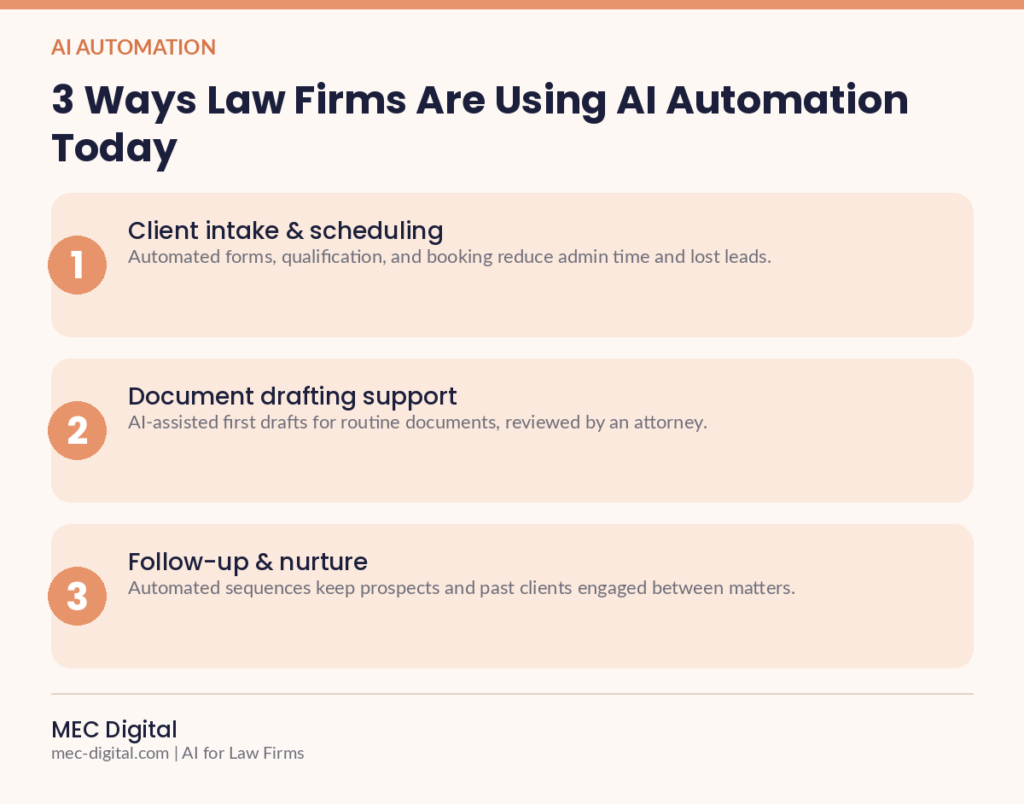
The most common applications aren’t glamorous: automated intake forms that route leads to the right practice area instantly, chatbots that answer common questions before a human ever gets involved, AI-assisted first drafts of routine documents that a lawyer then reviews and refines, and automated follow-up sequences that keep prospects warm without manual effort. None of this replaces legal judgment, it removes the repetitive work around it.
In-House Hire, Contractor, or Agency?
Most firms, even mid-sized ones, don’t need a full-time AI specialist on payroll. The workload doesn’t justify it, and the field moves fast enough that a dedicated in-house hire can fall behind. A contracted expert or an agency that specializes in legal automation typically delivers better value: you get current expertise without a six-figure salary commitment, and the relationship can scale up or down as your needs change.
What to Watch Out For
- Automating client-facing communication without clear disclosure that it’s AI, which erodes trust fast if discovered
- Using AI-generated content or documents without a lawyer reviewing them before they go out
- Ignoring confidentiality and data security requirements when choosing AI tools and vendors
Frequently Asked Questions
Will AI replace lawyers or paralegals at my firm?
No, and firms that frame it that way tend to get pushback from their own teams. The realistic framing is that AI removes repetitive, low-judgment tasks (intake triage, first-pass document review, routine correspondence) so your team spends more time on the work that actually requires legal expertise. It changes what people spend their time on, not whether they’re needed.
How much does it cost to bring in an AI automation expert?
It depends heavily on scope, a one-time intake automation project costs far less than an ongoing engagement covering multiple workflows. Most firms start with a single high-impact process (usually intake or document review) and expand from there once they see the time savings, rather than trying to automate everything at once.
Is it safe to use AI tools with confidential client information?
It depends entirely on which tools and vendors you choose. Consumer-grade AI tools are generally not appropriate for confidential client data, but enterprise-grade platforms with proper data handling agreements exist specifically for regulated industries like law. This is exactly why working with someone who understands both AI and legal compliance matters more than picking the flashiest tool.
Where should a law firm start with AI automation?
Intake is almost always the highest-leverage starting point: it’s the first impression a prospect gets, it’s repetitive, and improvements there directly affect how many inquiries convert into clients. From there, most firms move to document workflows and follow-up sequences once the intake process is running smoothly.
Our AI for Law Firms service helps you identify the right starting point and implement it safely, without disrupting the way your team already works. Get in touch to talk through where automation could save your firm the most time.

Hi, I’m Erwan, and alongside my wife Monica (former corporate lawyer turned branding expert), we help lawyers and law firms go from “great, but unknown” to recognized authorities in their field online. Here’s how it started: We began helping a few lawyers in our circle with their LinkedIn, their website, their online presence. Within weeks, we: - Attracted high-value cases and new clients - Got speaking invitations - Attracted top legal talent and associates We realized one thing: Most lawyers haven’t even started playing the game. That’s why the results come fast. Today, our team of ex-lawyers + branding and tech experts at M.E.C. Digital delivers a full done-for-you growth system, tailored for the legal industry. Here’s what we offer: - Done For You services: positioning, branding, LinkedIn, pitch, SEO article, outreach, networking, PR and Medias, .... we are your external CMO. - Mentoring: We work with you growing your authority online, increasing visibility and opportunities - Training & coaching: Individual or group training. Since 2023, we’ve helped 50+ law firms stand out, build influence, and grow, without sacrificing their time, reputation, or standards. ⸻ If you’re great at what you do but no one knows about it online, we should talk. Book a free consult at: https://calendly.com/mecdigitalerwan/ln Or visit: www.mec-digital.com
View All Articles