
AI has moved from a buzzword to a working tool inside law firms, but adoption is uneven. Some firms use it daily for drafting and research, while others are still deciding where it fits, or whether it fits at all. Missing that distinction is exactly what leads firms to waste budget on the wrong tools, or worse, mishandle client data. This guide breaks down what AI actually does well in a legal setting today, where the risk lies, and how to start using it without putting client work or bar compliance at risk.
What AI Can (and Can’t) Do for a Law Firm Today
Current AI tools are strong at first-draft work: summarizing documents, drafting routine correspondence, organizing discovery material, and answering intake questions. They are not a substitute for legal judgment, and they can produce confidently wrong answers, especially on case law citations. The firms getting real value treat AI output as a draft that a person reviews, not a finished product that goes out the door unchecked.
Where Law Firms Are Getting the Most Value from AI
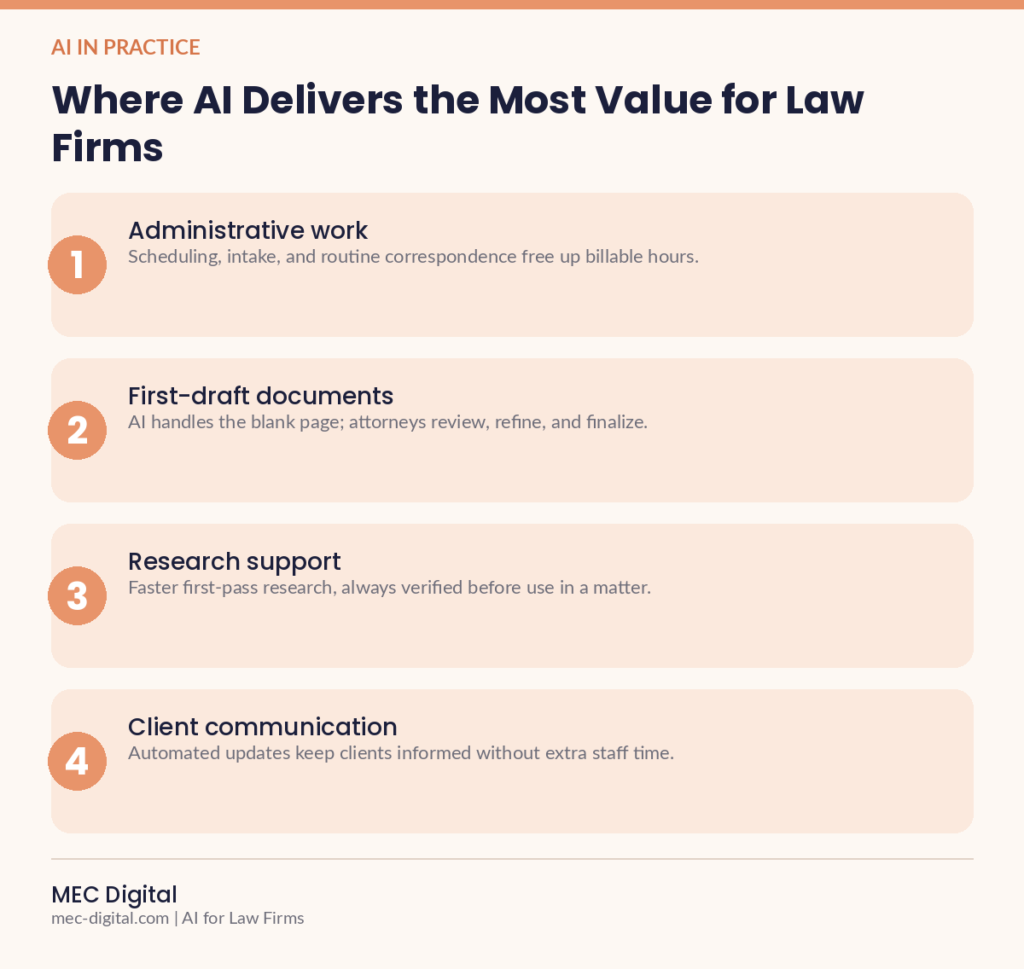
The clearest returns show up in tasks that are time-consuming but structurally repetitive. That includes:
- Document review: flagging relevant clauses or inconsistencies across large sets of contracts or discovery documents
- Legal research: surfacing relevant case law faster, with a human still verifying every citation
- Client communication: drafting first-pass responses to common questions that staff review before sending
- Internal knowledge: making firm precedent and past work product searchable instead of buried in old files
The Risks Firms Need to Manage: Confidentiality, Accuracy, and Bar Rules
The biggest risk is not the technology, it is how it gets used. Entering privileged client information into a public AI tool can create a confidentiality problem, since some tools use submitted data for training unless enterprise settings say otherwise. Fabricated case citations from unchecked AI output have already led to sanctions in several jurisdictions. Most state bars now expect lawyers to understand the tools they use well enough to supervise them, similar to the existing duty to supervise non-lawyer staff. Choosing tools built for legal use, with clear data-handling terms, avoids most of this risk from the start.
A Practical Starting Point for Firms New to AI
Start with a single low-risk use case, such as summarizing intake calls or drafting first passes of routine letters, and set a clear rule that a person reviews every output before it reaches a client. Choose tools designed for legal use rather than general consumer AI products, and confirm their data-handling policy before anyone enters client information. Once that first use case is running smoothly and the team trusts the output, expand to the next task rather than rolling out multiple tools at once.
Frequently Asked Questions
Is it safe to enter client information into AI tools?
Only if the tool has enterprise-grade data handling that keeps your inputs out of training data and secures them to a professional standard. General consumer AI tools often do not offer this by default, so it is worth confirming a tool’s data policy before using it with any privileged material.
Will AI replace paralegals or junior associates?
It changes the work more than it eliminates roles. AI handles first-pass drafting and document sorting, but someone still needs to review, verify, and apply judgment to the output, which remains a core part of paralegal and junior associate work.
What happens if AI gets something wrong in a filing?
The attorney who signs and files the document is responsible for its accuracy, regardless of how it was drafted. This is exactly why a human review step before filing is non-negotiable, not optional, whenever AI is involved in preparing a filing.
How do I get my team to actually use these tools?
Adoption improves when the tool is tied to a specific, visible time savings rather than introduced as a general mandate. Picking one workflow, showing the team how much time it saves them personally, and building the review step into the existing process works better than a firm-wide rollout all at once.
Our AI for Law Firms service helps you pick the right first use case and set it up with the review process and data safeguards a law firm needs. Get in touch to talk through where AI fits into your practice.

Hi, I’m Erwan, and alongside my wife Monica (former corporate lawyer turned branding expert), we help lawyers and law firms go from “great, but unknown” to recognized authorities in their field online. Here’s how it started: We began helping a few lawyers in our circle with their LinkedIn, their website, their online presence. Within weeks, we: - Attracted high-value cases and new clients - Got speaking invitations - Attracted top legal talent and associates We realized one thing: Most lawyers haven’t even started playing the game. That’s why the results come fast. Today, our team of ex-lawyers + branding and tech experts at M.E.C. Digital delivers a full done-for-you growth system, tailored for the legal industry. Here’s what we offer: - Done For You services: positioning, branding, LinkedIn, pitch, SEO article, outreach, networking, PR and Medias, .... we are your external CMO. - Mentoring: We work with you growing your authority online, increasing visibility and opportunities - Training & coaching: Individual or group training. Since 2023, we’ve helped 50+ law firms stand out, build influence, and grow, without sacrificing their time, reputation, or standards. ⸻ If you’re great at what you do but no one knows about it online, we should talk. Book a free consult at: https://calendly.com/mecdigitalerwan/ln Or visit: www.mec-digital.com
View All Articles